Updating a menu every week without losing Monday
A weekly menu workflow that fits in a morning: what to lock, what to swap, who signs off, when to reprint, and how to stop the card from eating the start of every week.
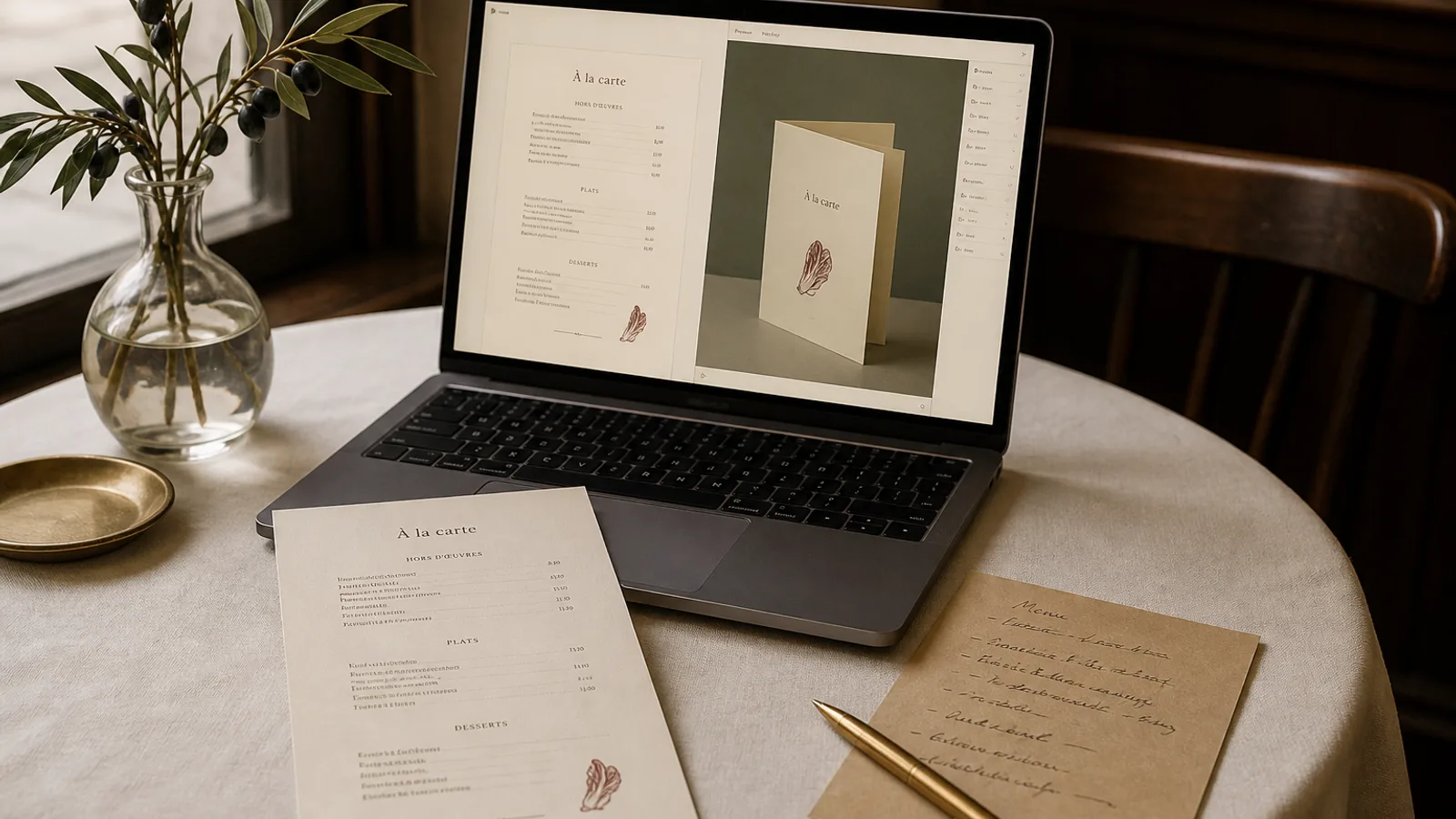
A kitchen that changes every week and a card that takes three days to update is how Monday becomes a design meeting. The dishes are ready; the PDF is not. Waiters recite specials that are not on the table, and by Thursday the card is already lying. The fix is not to print less often. It is to decide, once, which parts of the card are allowed to move, and to run those parts on a clock that fits in a morning.
Lock the bones on Sunday night, not on Monday morning
A weekly card has a stable frame: the restaurant name, the section words, the lunch formule structure, the drinks that do not change, the allergen key, the margins. Those objects should be a template nobody opens unless the brand moves. What moves is a short list: four to eight dishes, a plat du jour line, a glass of wine, a dessert. If more than a third of the card changes every week, you do not have a weekly menu; you have a new menu, and you should admit the time it takes.
Write the moving dishes in a shared note by Sunday evening: name, two or three components, price, allergen numbers. One person owns that note. A chat thread of five people editing "the fish" is how you print the wrong garnish.
Tuesday is too late for type
Typesetting is a Monday job if the card must be on tables for Tuesday lunch, and a Sunday job if you serve Sunday night. Block ninety minutes. The work is typing into the locked frames, checking that a long dish name does not crash into the price, and exporting a proof. It is not choosing a new typeface. If someone wants a new typeface, that is a quarterly conversation, not a weekly one.
- Proof on paper, not only on a phone. A 13 pt name that looked fine on a laptop can collide on A5.
- One reader who did not write the dishes reads the proof out loud. They will catch the missing accent and the 0 that should be a 9.
- Sign-off is one name: chef or owner. "Looks good to me" from three people is how you wait until 16.00.
Print the moving face; keep the rest
If the specials live on one face of an A5 or on an insert, you reprint that face or that slip, not the whole bifold. 160 to 250 g is enough for a weekly insert; the cover and the stable face stay on 350 g until they scuff. A dated line ("week of 8 June") on the insert tells the floor which stack to throw away. Undated weekly cards pile up in the waiter station and reappear in July.
Order a short run. Twenty to sixty cards is a week for most rooms. Soft-touch 350 g if the weekly face is the whole card and will be wiped; uncoated if it is a slip inside a cover. Do not laminate a weekly list. You will still be wiping last week's duck in a plastic sleeve.
What to do when a dish dies on Wednesday
Strike it with a pen in the same ink as the card, or reprint the insert overnight. A sticker is allowed if it matches the paper. A waiter speech as the only correction is how tables miss the replacement and order the ghost. If a dish dies every Wednesday, it should not have been on a printed weekly card; it belongs on the board.
Allergens move when the dish moves
Regulation 1169/2011 does not pause for a busy week. The numbered key must match the new lines. When you swap the fish, you swap its numbers, and you check that the legend on the back still covers them. A weekly card with last week's key is worse than no key: it is a confident lie. Keep the legend stable (the 14 names never change) and only retouch the numbers on the lines.
A calendar that survives holiday and staff change
Write the weekly loop on one page and leave it in the office: Sunday list, Monday set and proof, Monday print or Tuesday morning on tables, Wednesday strike or reprint if needed, Friday note for next week. When the owner is away, the loop still runs. A workflow that lives in one person's head is not a workflow; it is a single point of failure that looks like a designer.
If you use a tool that already holds the dishes, the logo and the format, the Monday hour is typing and a 3D check, not a rebuild. In Menu Atelier you keep the locked frame, swap the week's lines, switch A5 insert and A4 bifold if the list grows, see the fold in 3D, and download a 300 dpi PDF with 3 mm bleed or order the short run on 350 g matte board. The week starts with service, not with a layout.