Versioning menu designs: lunch, dinner, seasons, languages
Keep lunch, dinner, seasonal and language menus as one family: what to lock, what to vary, and how to name files so last week's card never goes to press.
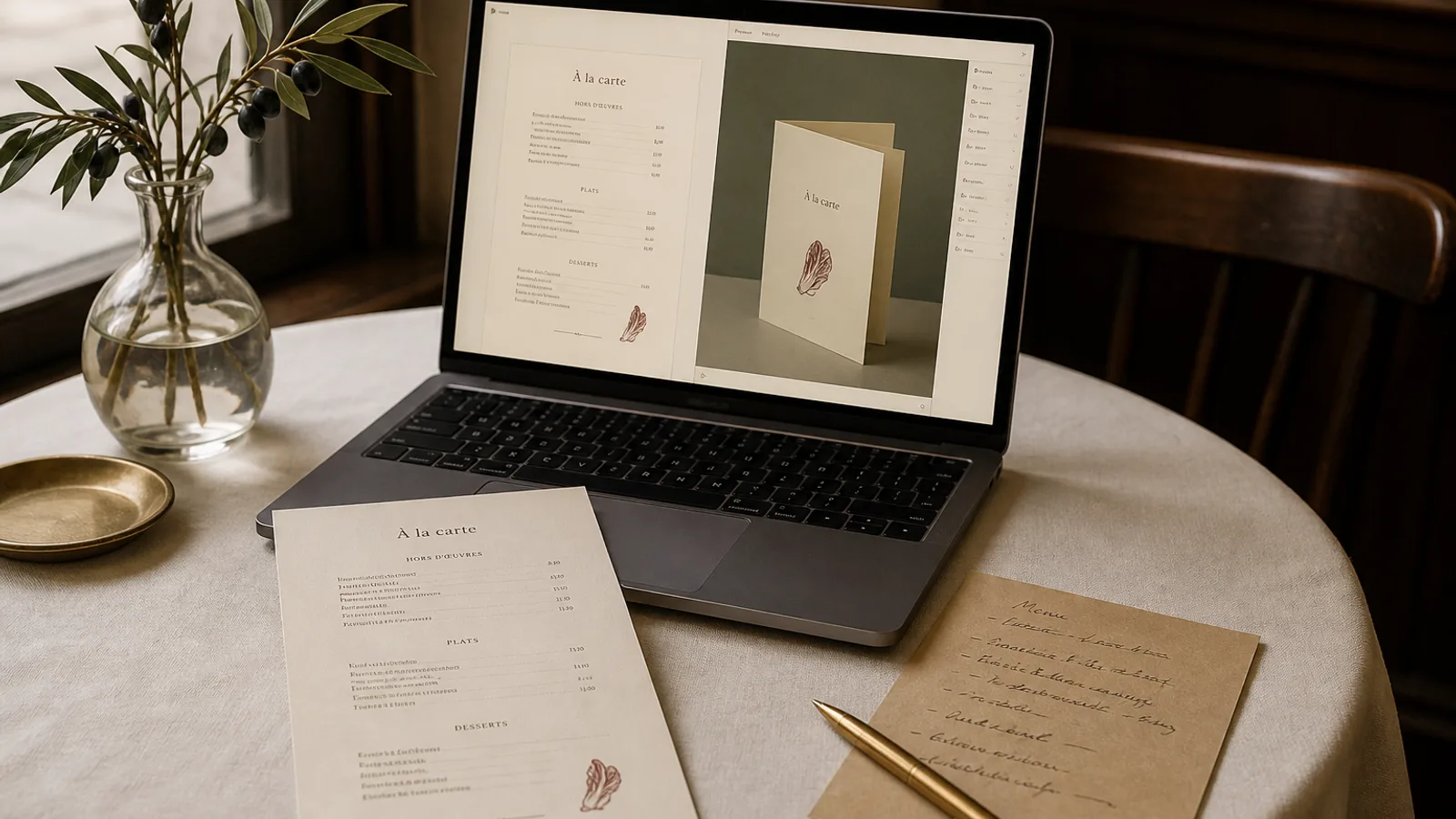
Most restaurants do not have one menu. They have a lunch card, a dinner card, a terrace list, a December menu, and a translation. Treated as five separate design jobs, those files drift within a month: the Spanish dinner uses a heavier heading than the French lunch, the winter wine list is still set in last summer's type, and someone reprints March from a PDF on the office desktop. Versioning is the unglamorous habit that keeps them as one family. This article says what to lock, what to vary, and how to name the files so the wrong Tuesday never goes to press.
Lock the family, vary the density
A version is not a new design. It is the same type pairing, the same palette, the same logo size, the same rule weight, on a different dish list or a different format. Lunch is usually denser and cheaper: a 18 to 28 € formula, six to ten à la carte lines, a short dessert. Dinner is longer, with more description and a wine column. If you redesign lunch from scratch you will get a café and a restaurant that do not recognise each other at 5 pm, when both cards are on the same table.
The practical lock list is short. Typefaces and their sizes for heading, dish, description, price. The colour of the board and the colour of the ink. Logo width on the cover, in millimetres, not "looks about right". Margin and gutter. Once those are written down, a seasonal rewrite is a content job, not a design job. You change mushrooms for tomatoes. You do not change the serif.
Lunch, dinner, and the 4 pm overlap
If both services run in the same room, the cards must be distinguishable at a glance and obviously related. Distinguish them with a single cue: a small word (Lunch / Dinner, or the service time) under the logo, or a different paper colour of the same family (warm white at noon, a slightly deeper cream at night). Do not distinguish them with a different typeface. Guests who stay through will notice the cousinship; staff who grab the wrong stack will notice the word.
Format can change. A lunch formula often wants a single A5 face; dinner wants an A4 or an A5 bifold. That is a reflow, not a redesign. Keep the same hierarchy and let the columns adapt. If the dinner wine list will not fit the lunch format, it does not belong on the lunch card. Put it on the back or on its own sheet, in the same type.
- Same type, colour, logo size and rule weight on every version
- One visible cue that names the service (word or paper tone), never a new typeface
- Reflow between A4, A5, single sheet and bifold instead of drawing a second design
- Wine, dessert and kids as satellite cards in the same family, not as independent jobs
Seasons without a costume change
A seasonal version is the same card with a different list and, at most, one shift in the palette: a slightly deeper green in November, a lighter cream in May. It is not a new illustration of pumpkins, nor a gold overlay for December. Guests should recognise the restaurant in January. If you need a festive cover for New Year's Eve, make that a one-night card and keep the January à la carte in the family dress.
Plan the reprint before you write the dishes. A 350 g run of 50 copies at 99 € plus 10 € each is a real cost; you do not want to reprint because the asparagus arrived a week early and the card still says peas. Leave two or three lines as "market fish" or a dated insert if your suppliers move faster than your print cycle. The insert should be the same type at the same size, printed on a lighter sheet if you must, never a handwritten sticky note on a designed card.
Languages: one design, several texts
A French card and an English card are not two designs. They are one design with two strings. Descriptions grow and shrink: German will often run 20 percent longer than English, French sits in between, Italian can be shorter if you drop the adjectives. Design for the longest language, then set the others in the same measure. Do not tighten tracking on the German to make it fit; cut words.
Never mix languages on one line unless the room is genuinely bilingual and the second language is a translation of the first, in a lighter weight or a smaller size. A dish name in Italian and a description in English is a choice; a dish name in both, stacked, is usually noise. Allergen keys under Regulation 1169/2011 must appear in a language the guest can read. If you hand an English card to a table, the key on that card is in English.
Prices stay in euros
Do not create a sterling version of a Paris card, or a dollar version of a Lisbon card, unless you actually charge in that currency. Conversion on the menu is a gift to arguments. One currency, tabular figures, same decimal style on every language version.
Name the files so last week cannot be printed
A folder called Menu Final Final 2 is how March gets reprinted in June. Use a pattern you can sort: venue, service, language, date. For example rivoli-dinner-fr-2026-06-12. The date is the date the content was signed off, not the date someone exported a PDF. When June is approved, move May to an archive folder. The print file that leaves the building has one name and one date.
Keep a source, not only a PDF. The source is what you edit in September. The PDF is what you send this week. If the only file you have is last winter's print PDF, you will rebuild the design to change three prices, and the rebuild will drift. Export a new print bundle from the current source every time the list changes. One source, many outputs.
A weekly habit, not a project
Versioning fails when it is treated as a redesign. It works when Tuesday's price change is a five-minute edit on the dinner source, a regenerate of the lunch reflow, and a new date in the filename. The family stays locked. The stack on the pass matches. The guest who came in March and comes back in October still knows where they are.
In Menu Atelier you keep one design and switch format in one click, from A4 single sheet to A5 bifold, then generate lunch, dinner or language variants from the same dishes and the same mood; the 3D preview and a 300 dpi export with bleed are identical across versions, so the family resemblance is not a hope, it is the default.